
HS classification is often treated as a one-off technical exercise: read the rules, decide the code, move on. That approach breaks down as product catalogs grow, supplier inputs vary, teams change, and audits demand consistency. Compliance leaders need a system that makes classification repeatable, reviewable, and fast enough to support onboarding and daily operations.
This guide focuses on operationalizing the HS classification process across products and stakeholders. You will find a practical workflow, clear ownership, the minimum data you need from engineering and suppliers, and documentation practices that improve consistency without turning every decision into a long memo.
What the HS classification process means (and what it is not)
The HS classification process is the end-to-end workflow used to assign, validate, document, and maintain HS or HTS codes for imported or exported goods. It includes:
– Intake: collecting product facts that drive classification
– Analysis: determining the correct heading, subheading, and any national tariff line as applicable
– Decisioning: capturing the rationale and approvals
– Operationalization: making the code usable in ERP, PLM, PIM, and broker instructions
– Maintenance: monitoring changes in products and tariff schedules, and triggering reclassification when needed
What it is not:
– A single person “knowing the codes” from experience
– A broker-only activity with no internal controls
– A static spreadsheet that is updated sporadically
For most organizations, classification quality is less about knowing every rule and more about controlling inputs, standardizing decisions, and ensuring the same product is classified the same way every time, even when people or suppliers change.
Why teams struggle to operationalize classification
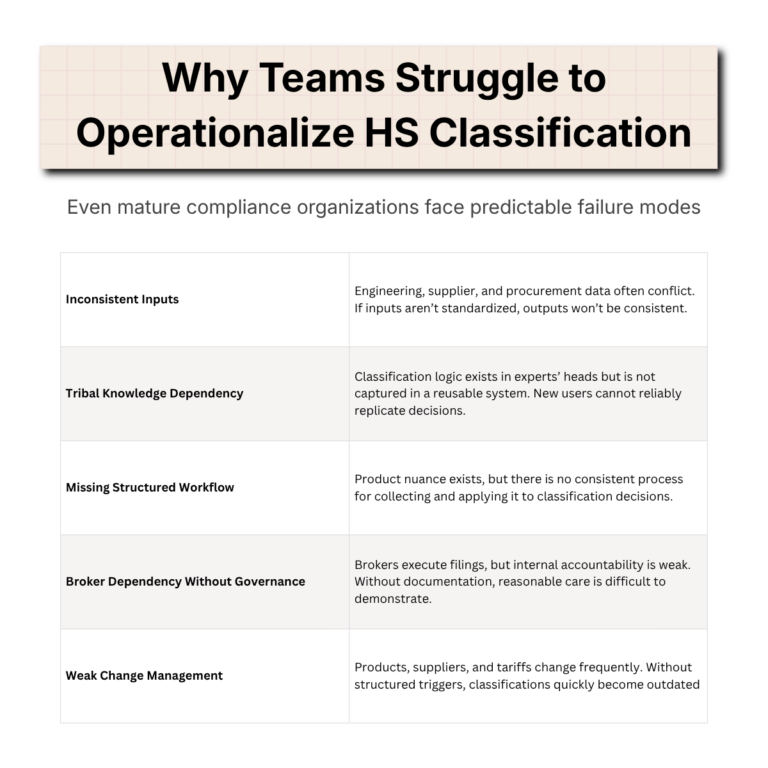
Even mature compliance organizations face predictable failure modes:
1) Inconsistent inputs
Engineering descriptions, supplier invoices, and procurement specs often conflict. If the data is not standardized, the classification output will not be either.
2) Decisions trapped in tribal knowledge
A few specialists understand the logic, but the reasoning is not captured in a durable format. New hires and brokers cannot replicate decisions confidently.
3) Product nuance is real, but the workflow is missing
Classification depends on materials, function, and construction details. The nuance is manageable when you have a workflow that consistently collects those details and ties them to the decision.
4) Broker dependency without governance
Brokers can execute, but the importer remains accountable. Without internal review and a documented rationale, you cannot demonstrate reasonable care.
5) Change management is weak
HS/HTS schedules change. Products change. Suppliers substitute components. A classification process must include triggers and periodic review.
The goal is not to eliminate expert judgment. The goal is to make expert judgment reproducible and auditable.
A practical framework: the 7-stage HS code assignment process
Below is a repeatable tariff classification workflow you can apply across categories. It is designed to scale from a few SKUs to thousands.
Stage 1: Product intake and scoping
Define what is being classified and for which jurisdictions.
– Identify the item and its commercial name(s)
– Confirm the country schedule needed (HS is harmonized at 6 digits, but duty assessment is typically at or national tariff line level)
– Establish the “unit of classification” (each, set, kit, assortment)
– Determine the transaction context (import for consumption, temporary import, repair/return)
Stage 2: Minimum data collection (standardized)
Collect the attributes that most often drive HS outcomes. Use a structured template rather than free text.
– Function and principal use
– Materials by weight or value where relevant
– Manufacturing process (e.g., cast vs forged vs extruded)
– Technical specs (voltage, power, capacity, dimensions)
– Composition and construction (layers, coatings, components)
– Whether it is complete, unfinished, or a part
– Whether accessories are included and how packaged
– Photos, drawings, SDS, datasheets
A common control: require a “classification-ready” dossier before analysis begins. This prevents cycling between compliance and engineering.
Stage 3: Screening for special cases and dependencies
Before deep analysis, quickly flag conditions that frequently change the path.
– Sets, kits, or retail packages
– Parts vs complete goods
– Multi-function products
– Software, digital elements, or embedded connectivity
– Goods potentially subject to additional programs (e.g., special duties, controls) depending on jurisdiction
Stage 4: Classification analysis and code proposal
Perform the technical classification steps appropriate to your jurisdiction, but in a standardized way. The point here is not to restate legal rules in the abstract, but to structure how your team applies them.
– Identify candidate chapters based on function and material
– Narrow to heading by principal function or description
– Validate subheading by specific attributes (e.g., material composition, capacity, type)
– Document decision points and what data supported them
Stage 5: Rationale and documentation (audit-ready, not essay-length)
Capture a compact rationale that someone else can follow. A useful format is:
– Product summary: 1 to 2 sentences
– Critical attributes: bullets of what mattered
– Considered alternatives: the top 1 to 3 codes you ruled out and why
– Final code: HS 6-digit plus national tariff line if applicable
– Source references: tariff notes, explanatory notes, prior internal decisions, supplier evidence
– Decision owner and date
This supports audit readiness, reduces rework, and improves consistency without creating unnecessary paperwork.
Stage 6: Review, approval, and release to operations
Define who approves what, and how the code becomes operational.
– Approval tiers based on risk: value, duty impact, regulated products, high volume
– Peer review for first-time classifications
– Release checklist: ERP item master update, broker instructions, entry templates, landed cost models
If your organization also relies on duty estimation, ensure classification outputs flow into duty calculations consistently. A productized feature view such as the Tariff Calculator can help stakeholders align on how classification data is used downstream.
Stage 7: Maintenance and change control
Treat classification as a living record.
– Trigger events: new supplier, design change, material change, packaging change, tariff schedule updates
– Periodic review cadence for high-risk categories
– Version control: keep prior codes and rationales with effective dates
– Exception management: handle disputes with brokers or customs feedback
This seven-stage approach turns a technical task into a managed business process.
Roles and governance: who owns what in the customs classification process
A scalable process requires explicit roles. A common governance model looks like this:
– Trade compliance (owner)
Defines the standard, performs or supervises classification analysis, approves codes, maintains documentation.
– Engineering or product (data authority)
Provides technical attributes and confirms changes that could affect classification.
– Procurement and sourcing (supplier enforcement)
Ensures suppliers provide required data and notify changes. Builds documentation requests into supplier onboarding.
– Logistics and import operations (execution)
Ensures operational systems and broker instructions use the released code. Flags discrepancies at entry.
– Customs broker (execution partner)
Files entries and may propose codes, but operates within the importer’s governance. Broker input is valuable, but it should not be the only record of decisioning.
– Finance (impact awareness)
Uses classification for landed cost and margin analysis. Helps prioritize classification for high spend items.
Key governance controls:
– A single “system of record” for HS/HTS decisions (even if multiple systems consume it)
– A defined escalation path for disagreements
– An approval matrix tied to risk, not title
– A measurable backlog and SLA for new SKU classification
When someone says “we already have a process,” ask: can a new analyst follow it and produce the same answer with the same inputs? If not, you may have a practice, not a process.
Standardizing product data intake: the fastest way to improve consistency
Most classification variance is caused by inconsistent product descriptions, not by the tariff schedule. Standardization starts with intake.
Build a classification intake form that:
– Uses controlled fields (dropdowns, numeric fields) for attributes that matter
– Separates “marketing description” from “technical description”
– Requires evidence attachments (drawings, photos, SDS, BOM extracts)
– Includes a change declaration (what changed since last version)
Recommended “minimum viable” intake fields:
– Product family and internal SKU
– Function and principal use (plain language)
– Material composition (primary and secondary)
– Key technical ratings (power, voltage, capacity)
– Manufacturing process if relevant
– Included accessories and packaging configuration
– Country of origin (not always needed for classification, but essential downstream)
– Supplier part number and datasheet link
This is also where you address the objection “documenting this would take too long.” The goal is not a long narrative. The goal is structured data that prevents repeated follow-up questions and reduces reclassification churn.
How to handle product nuance without losing standardization
Classification depends on nuance, and that is exactly why you need a system. Standardization does not mean forcing every item into a simplistic template. It means treating nuance consistently.
Tactics that work:
– Decision trees by product family
Create a short guided flow that asks the discriminating questions for that family. Example: for apparel, fiber content and knit vs woven. For machinery, principal function and included components.
– Attribute-driven “reason codes”
When an analyst selects a code, require a few standardized reason codes such as “principal function,” “material composition threshold,” or “part of.” This helps later reviewers understand the logic without reading paragraphs.
– A controlled list of “classification-sensitive attributes”
For each product family, maintain a short list of attributes that, if changed, must trigger review.
– Pre-approved positions for common items
For repeat products, define a pre-approved classification position with boundaries. Example: “Model series X with housing material Y and power rating within range Z.”
Nuance becomes manageable when it is surfaced early, documented in the same pattern, and tied to a clear review trigger.
Documentation that stands up to audits: what to keep and how to store it
Audit-ready does not mean storing everything. It means storing the right evidence, linked to the decision.
A practical documentation package per SKU or product family:
– Classification record (code, description, effective date, owner)
– Rationale summary (why this code, why not close alternatives)
– Supporting evidence (datasheets, photos, BOM snippet, supplier composition statements)
– Approval record (who reviewed and when)
– Change log (what changed and whether reclassification was required)
Storage guidance:
– Keep evidence linked to the SKU or classification ID
– Ensure version control for product revisions
– Make records searchable by SKU, supplier, product family, and HS code
This documentation approach supports the proof points you should care about: standardizing classification across teams, reducing reliance on tribal knowledge, improving consistency, enabling faster onboarding of new SKUs, and supporting audit-ready documentation, without overstating outcomes.
FAQs
A practical sequence is: (1) collect classification-ready product data, (2) screen for sets, parts, and other special cases, (3) analyze and propose the HS/HTS code, (4) document a concise rationale with evidence, (5) complete review and approval, (6) release the code to ERP and broker instructions, and (7) monitor changes that could trigger reclassification.
Standardize the shared core first: a single HS 6-digit position with a consistent product description, attribute set, and rationale. Then map that position to country-specific tariff lines with jurisdiction-specific notes and effective dates. Store both the shared logic and local extensions in the same record so updates do not drift.
At minimum, keep your own classification register with the released code, product identifiers, effective dates, a short rationale, and supporting evidence. Also keep an exception log when the broker proposes a different code and how it was resolved. This helps demonstrate reasonable care and prevents inconsistent filings across brokers or ports.
Review when triggers occur, not only on a calendar. Common triggers include product design changes, material or supplier substitutions, packaging changes that affect set or kit treatment, and annual or periodic tariff schedule updates. For high-risk or high-volume categories, add a periodic sampling review to catch drift between released codes and filed entries.
You typically need a classification record (code and description), the key attributes that drove the decision, a brief rationale including alternatives considered, supporting evidence such as datasheets or BOM excerpts, and approval and change history. The documentation should be searchable and linked to the SKU so you can retrieve it quickly under audit conditions.
If you want HS classification to be consistent, scalable, and easier to defend, the priority is a repeatable workflow with standardized inputs, clear approvals, and audit-ready records. See how to standardize your classification process across all products and teams with Quickcode.ai.