
Find the misclassified SKUs before CBP does.
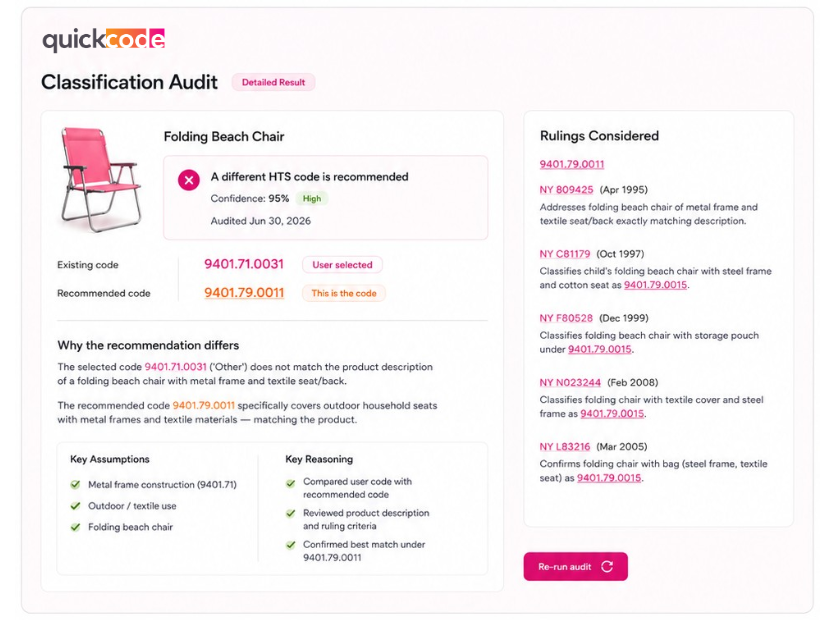
Classification Audit scans your product catalog against current regulations and CROSS rulings and flags every line item that may be misclassified, underclassified, or sitting on stale data, so you catch the exposure on your terms, not during a CBP review.
The results are more consistent than manual review, and when the system identifies a potential issue or lacks sufficient confidence, it flags the item for your review instead of making assumptions. You remain in control of every classification decision, choosing whether to update the HTS code or leave it unchanged. Every decision is yours.
Your catalog grew faster than your classifications.
Most catalogs are classified once, at onboarding, and never revisited. Rulings change, suppliers swap materials, and new SKUs get coded by whoever was free that week. The result sits quietly in your system until an audit or a customs hold brings it to the surface.
Without Classification Audit
- Classifications are checked SKU by SKU, when someone happens to notice a problem.
- Outdated rulings stay in place until a broker or auditor flags them.
- Compliance teams spend hours cross-referencing HTS codes by hand.
- Risk exposure is discovered after entry, when penalties and back duties are already on the table.
With Classification Audit
- The catalog is scanned in one pass.
- Stale or superseded classifications are flagged automatically.
- Compliance teams review a prioritized list instead of starting from scratch.
- Potential exposure is identified and corrected before the next purchase order or entry filing.
- Every classification audit includes full reasoning behind the suggestion.
How it works: From catalog to decision-ready insights in four steps.
No new data entry. Classification Audit works against the product data you already have.
Upload
Connect your catalog
Import your SKU list directly or sync from your existing ERP or PLM system in its current format.
Scan
Audit against current regulations
Every line item is checked against the current HTS schedule, rulings, explanatory notes, HTSUS notes, and informed compliance publications.
Flag
Review prioritized exceptions
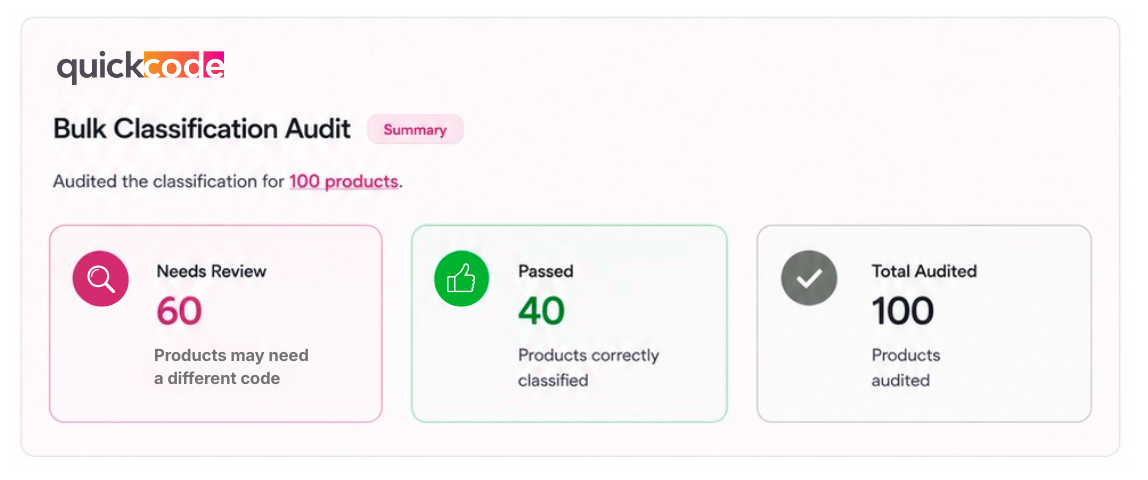
Get a list of misclassified, underclassified, and outdated line items, with the reasoning behind each flag.
Resolve
Correct and document
Accept suggested reclassifications or override with your own determination. Every decision is logged for your audit trail.
Built for the catalog you inherited
You’re responsible for classifications you didn’t make.
Most compliance teams are managing catalogs that have grown for years, coded by people who have since moved on. The Classification Audit feature gives you a way to get on top of that backlog, and stay on top of it, without auditing every line item by hand.
For compliance managers and directors
Finally, a complete picture of your catalog
- Audit a catalog that’s too large to review by hand, without missing the SKUs that matter most
- Surface classifications made by previous employees that may no longer reflect current regulations and rulings
- Keep a documented, timestamped trail of every classification decision
- See the reasoning behind every flag, and decide whether to update the code or accept it as is
For purchasing, sourcing, and planning teams
Answers before the PO, not after
- Model landed cost, margin, and tariff exposure on a SKU before placing an order
- Get a tariff answer in minutes instead of waiting on a compliance ticket
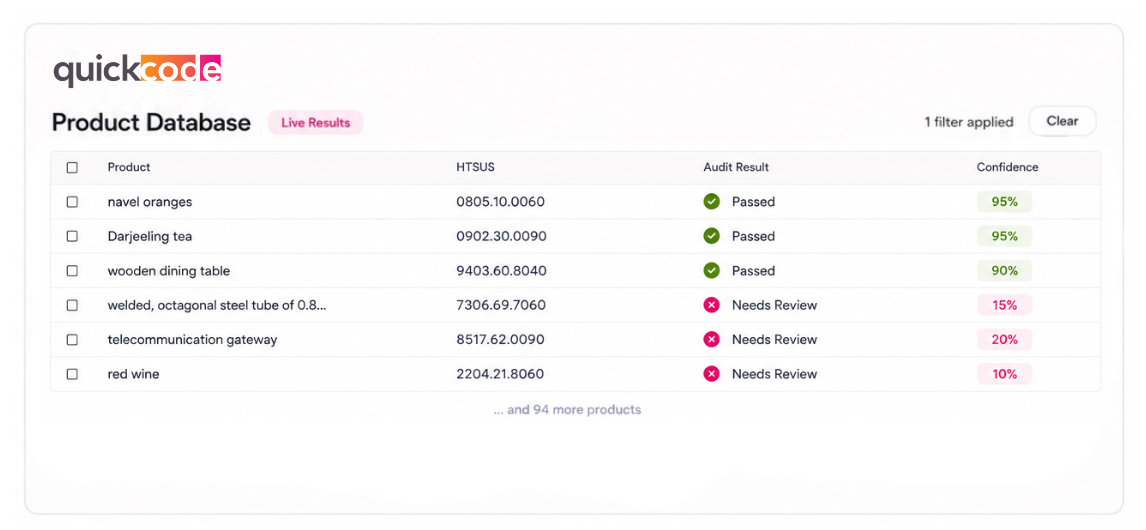
- See which classifications are already confirmed and which are pending review
- Move on routine SKUs while compliance focuses attention where it is needed
What teams ask before signing up.
One audit covers one SKU/product. Quickcode uses all provided product information during the audit, including product name, descriptions, material composition…even SKU.
No. Classification Audit is built to work against catalog exports and ERP data in the format you already have. Our team will walk you through the import during onboarding.
No. Classification Audit is a detection and prioritization tool that helps your team find and resolve likely issues faster. Final determinations on complex or high-risk items should still involve your broker or counsel as needed.
You will get a full readout of your results and a conversation with our team about ongoing pricing. There is no obligation to continue after the trial audit.