
Most trade compliance guidance explains how tariff classification should work: read the headings, apply the notes, select the correct HTS. In day-to-day operations, that ideal breaks down. The same product gets classified differently by different brokers. A supplier description changes and no one notices. An ERP item record is copied forward and slowly drifts from reality.
This post focuses on the most common HTS classification mistakes that recur across teams and systems, why they persist even in experienced organizations, and how to reduce them with standardized processes and continuous validation. If you manage import compliance, global trade, customs brokerage, or landed cost, the goal is practical: fewer exceptions, fewer post-entry fixes, and fewer surprises at audit time.
What counts as an HTS classification mistake (and why it matters)
An HTS classification mistake is any situation where the code on an entry does not match the product as imported, under the applicable legal text and interpretive rules. In practice, mistakes usually fall into three buckets:
1) Wrong code selected (misclassification). This often happens when the product is similar to another item, but a key attribute changes the heading or subheading.
2) Inconsistent code usage. The same product appears under multiple HTS codes across brokers, business units, or plants, even if one of the codes could be defensible.
3) Stale or unsupported classification. The code might have been correct once, but the product, BOM, materials, manufacturing process, or end use changed, and the supporting rationale did not.
Why it matters is not limited to duty rate. Classification drives admissibility, PGA requirements, marking expectations, preferential treatment eligibility, and how you defend your decisions. Operationally, classification errors create rework: entry corrections, broker disputes, purchase order holds, and time-consuming explanations to finance and leadership when landed cost shifts unexpectedly.
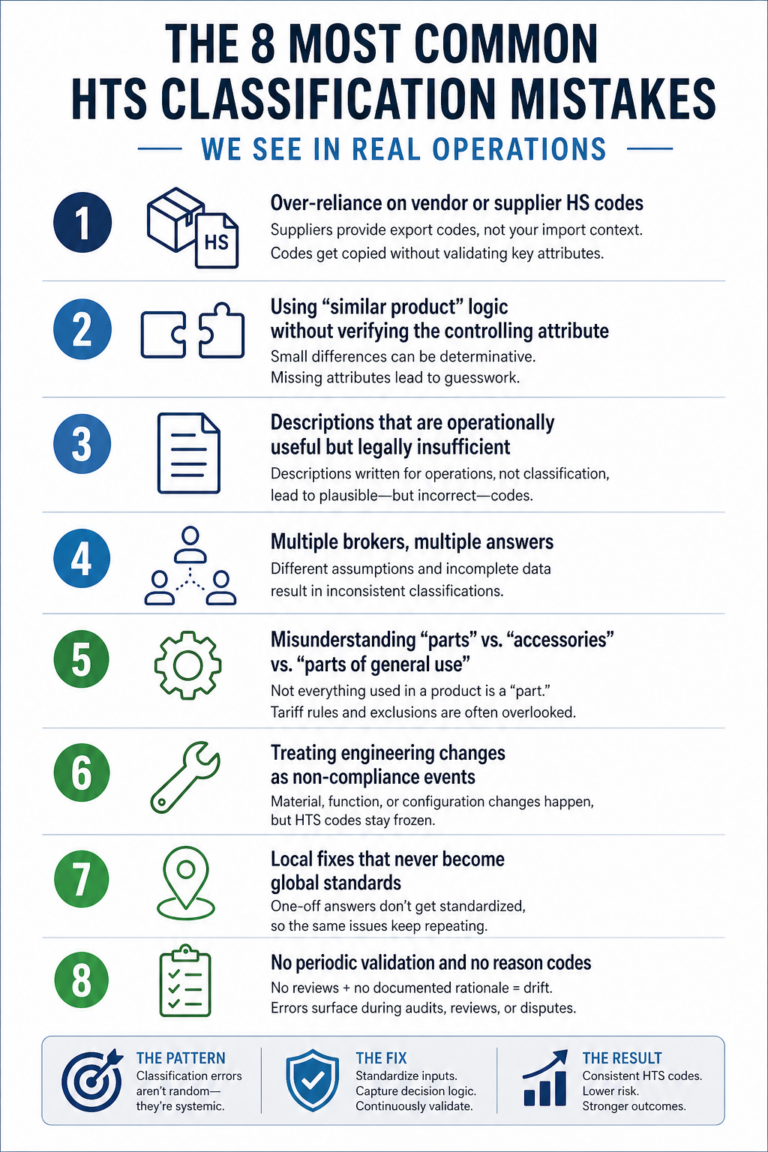
The 8 most common HTS classification mistakes we see in real operations
Below are patterns that show up repeatedly across import entries, internal teams, and customs brokers. They are less about knowledge gaps and more about how classification work is requested, documented, and maintained.
1) Over-reliance on vendor or supplier HS codes
Suppliers often provide HS codes for their export context, not your import context. Even when the first six digits align, national-level subheadings can differ. Teams copy the supplier code into item master data and treat it as authoritative. This is a common source of hs code errors because no one validates the attributes that actually drive the subheading.
2) Using “similar product” logic without verifying the controlling attribute
A classic tariff classification mistake is assuming “it’s basically the same as last time.” Small differences can be determinative: material composition, whether a component is mounted, whether a product is a part versus an accessory, power rating, or whether it is a kit. When the controlling attribute is missing from the description, the code selection becomes guesswork.
3) Descriptions that are operationally useful but legally insufficient
Many item descriptions are written for purchasing or warehouse needs, not classification. “Plastic fitting,” “steel bracket,” or “electronic module” may be enough to receive goods, but not enough to classify. When brokers receive sparse data, they pick a plausible code and move on. This is how incorrect HTS codes persist even in experienced organizations.
4) Multiple brokers, multiple answers
Organizations often assume a broker ensures accuracy. In reality, different brokerage teams apply different assumptions, rely on different prior entries, or interpret incomplete product data in different ways. The result is inconsistency, not necessarily malicious error. Over time, this becomes a customs classification issue because you cannot show a controlled, repeatable process.
5) Misunderstanding “parts” versus “accessories” versus “parts of general use”
Many import classification errors come from forcing an item into a “parts of” provision without checking whether the tariff excludes it, whether it is a part of general use, or whether it has its own more specific heading. A fastener, bracket, or generic housing may not classify as a “part” of the finished machine even if it is used there.
6) Treating engineering changes as non-compliance events
Engineering change orders frequently affect classification drivers: materials, coatings, electronics added, moving from manual to powered operation, packaging as a set, or adding a consumable. If the ECO process does not flag trade compliance review, the HTS stays frozen while the product changes.
7) Local fixes that never become global standards
A compliance analyst resolves a classification question for one shipment, one plant, or one broker. The answer is not promoted into a governed master record, so the same question returns repeatedly. This “ticket loop” is a hidden cost and a key reason errors feel like edge cases when they are actually systemic.
8) No periodic validation and no reason codes
Even strong teams can drift if classifications are not periodically revalidated. HTS databases change, business use cases shift, and item descriptions degrade. Without documenting the rationale, source documents, and the attributes that drove the decision, it is hard to detect or correct drift. This is where inconsistencies across import entries become visible during audits, post-entry reviews, or supplier disputes.
If you want a practical walkthrough of how teams gather product attributes and narrow to a code, take a look: Find the Right HS Tariff Classification.
Why these mistakes persist even with experienced teams
The most common objection is, “Our team is experienced and doesn’t make these mistakes.” Experience helps, but it does not eliminate the structural causes.
Classification is a cross-functional workflow, not a single decision:
– Data originates in sourcing and suppliers, often incomplete.
– Engineering owns the product reality, but changes are not always communicated to compliance.
– ERP and PIM systems store item data, but they are optimized for procurement and fulfillment, not legal interpretability.
– Brokers classify at speed, sometimes with minimal product context.
– Finance cares about landed cost stability, but usually engages after a variance appears.
Because the work is distributed, errors are rarely obvious at the moment they happen. They show up later as duty variance, an exam, a request for information, or an internal audit finding. That lag makes the problem feel rare, even when it is repeating quietly across SKUs.
Another objection is, “our broker ensures accuracy.” Brokers are critical partners, but they are not the governance layer for your product master. If they receive inconsistent descriptions or no controlled classification library, they will produce inconsistent outputs. The durable fix is process ownership plus validation, then letting brokers execute within that controlled standard.
A practical prevention framework: Standardize, Validate, Govern
To reduce tariff classification mistakes without slowing operations, use a three-part framework. It is intentionally operational, because the failure patterns are operational.
1) Standardize the inputs
Define the minimum product attributes required to classify for your common categories. Examples:
– Material composition and percentages where relevant
– Function and principal use
– Technical specs that drive subheading selection (power, size, capacity)
– Whether it is a complete article, a part, an accessory, or a set
– Packaging configuration and whether components are imported together
– Any coatings, treatments, or special manufacturing steps
Implement these as required fields or structured prompts in your intake workflow. The aim is to stop “generic noun” descriptions from reaching classification.
2) Validate continuously, not just at onboarding
Validation should happen at multiple points:
– New item introduction: confirm the attributes, proposed code, and rationale.
– Broker entry review: compare declared codes against your internal library and flag deviations.
– Change management: route ECOs and supplier changes through a classification impact check.
– Periodic sampling: target high-risk families (high duty variance, frequent changes, high volume) for revalidation.
Continuous validation directly addresses the reality that errors are not one-time events. They are the outcome of drift and inconsistent execution.
3) Govern as a controlled library, not a spreadsheet
A classification library should function like a controlled system of record:
– One approved code per SKU or per clearly defined product variant
– Documented rationale and the attributes that drove the decision
– Versioning and effective dates when items change
– Clear ownership and approval workflow
– Exception handling when brokers or teams disagree
This is the layer that prevents multiple brokers from producing multiple answers. It also makes audits faster because you can show that classifications are repeatable and based on defined inputs.
If you are evaluating how technology might support standardization and governance, you may find this perspective useful: Will HS Classification Be Replaced by.
HS code misclassification examples (patterns to watch for)
Rather than listing specific HTS numbers, these examples focus on the kind of attribute gap that causes misclassification.
Example 1: “Plastic fitting” with missing material and use case
If the product could be a pipe fitting, a furniture component, or a part of a machine, the heading depends on what it is and how it is used. When the description is generic, teams default to a familiar code. The fix is requiring the material type, intended system, and whether it is for piping.
Example 2: “Control module” without function, connectivity, or end use
A module might be a power supply, a controller, a communication device, or part of a larger apparatus. Classification often depends on principal function and the machine it belongs to. The fix is collecting function, technical datasheets, and system context.
Example 3: “Steel bracket” treated as a machine part
Some items used in machines still classify under general headings because they are generic articles. The fix is checking whether the product is a general-use item versus something that is solely or principally for a particular machine.
These are not edge cases. They occur when product data is optimized for purchasing and fulfillment, then forced into compliance decisions later.
How to audit your current process for systemic customs classification issues
If you suspect errors are “rare,” test that assumption with an operational audit focused on inconsistency and drift.
Step 1: Pull a 90-day slice of entries and group by SKU
Look for SKUs that appear under multiple HTS codes, or codes that vary by broker, port, or business unit.
Step 2: Identify the top 20 SKUs by duty paid or volume
High-impact items deserve the most robust documentation and revalidation cadence.
Step 3: For each SKU, inspect the supporting data quality
Check whether your item record includes the attributes needed to justify the code. If your record would not let a new analyst reproduce the decision, it is a risk.
Step 4: Trace where the code originated
Was it supplier-provided, broker-selected, copied from a similar part, or approved internally? This reveals where standardization is failing.
Step 5: Put corrective actions into the workflow, not a one-time cleanup
The goal is not a classification project that ends. The goal is a controlled pipeline that keeps classifications accurate as products and suppliers change.
For more trade compliance topics and practical operations-focused guidance, see Quickcode’s Blog Posts.
FAQs
Brokers often work from the product descriptions and prior entries they have on hand. If different brokers receive different descriptions, or if there is no single governed classification library, they can reach different defensible conclusions or make different assumptions. Consistency usually requires an internal standard for product attributes, an approved code library, and a process to resolve and publish changes.
The visible errors are often just the ones that surfaced through an exam, a duty variance, or an internal review. Many organizations have low visibility into quiet inconsistency across SKUs and brokers. Fixing the process is often less about chasing individual errors and more about reducing rework, stabilizing landed cost, and improving audit defensibility.
Standardize the minimum product attributes required for classification and embed them in the intake process. Then validate declared codes against your approved library and flag deviations for review. This approach prevents low-quality inputs from turning into last-minute shipment holds.
Treat engineering changes as potential classification triggers. Route ECOs through a lightweight classification impact check that asks whether materials, function, configuration, packaging, or end use changed. If yes, revalidate the code and update the rationale and effective dates in your controlled library.
Maintain the product attributes that drove the decision, the rationale tied to the legal text and notes as applicable, and supporting documents such as datasheets, material declarations, drawings, and packaging configuration. Also keep version history and effective dates so you can show how and why a classification changed over time.
HTS classification mistakes are rarely a knowledge problem and usually a workflow problem: inconsistent inputs, inconsistent execution, and no validation loop. If you want to reduce hs code errors across teams and brokers, the path is standardization plus continuous checks and governance. See how to eliminate classification mistakes with a standardized, system-driven process.